
Hedwig Grossman and Rudi Lehmann


Hedwig Grossman (1902–1998) and Rudi Lehmann (1903–1977), both born in Germany, met at the Municipal Arts and Crafts School of Berlin (in the 1920s. Their friendship grew into a partnership – in life and in art – that lasted for decades. Grossman came from a prosperous Jewish family and was a member of the Blau-Weiss ("Blue-White") Zionist youth movement. It was her vision that drove them both to emigrate to Eretz Yisrael when the Nazis rose to power in 1933 – not simply as an escape route, but as a way of realizing an ideological project: to contribute to the founding of a new culture by developing a uniquely Israeli artistic language. Lehmann, born a Christian in Berlin, lost his parents in childhood and was raised by an adoptive family. He harnessed his talent to his partner's vision and became one of the pillars of the developing art scene of the Yishuv and, later, of Israel.
Their work was pioneering. Grossman is considered one of the founding figures of Israeli ceramics, celebrated for the way her work drew on local archaeology in both form and material. Lehmann laid the foundations for organic and modernist sculpture in Israel and shaped generations of artists through his teaching. Their lives and work were deeply intertwined: having no children, they devoted all their energy to creation, as well as to the care of pets, which occupied a central place in their world.
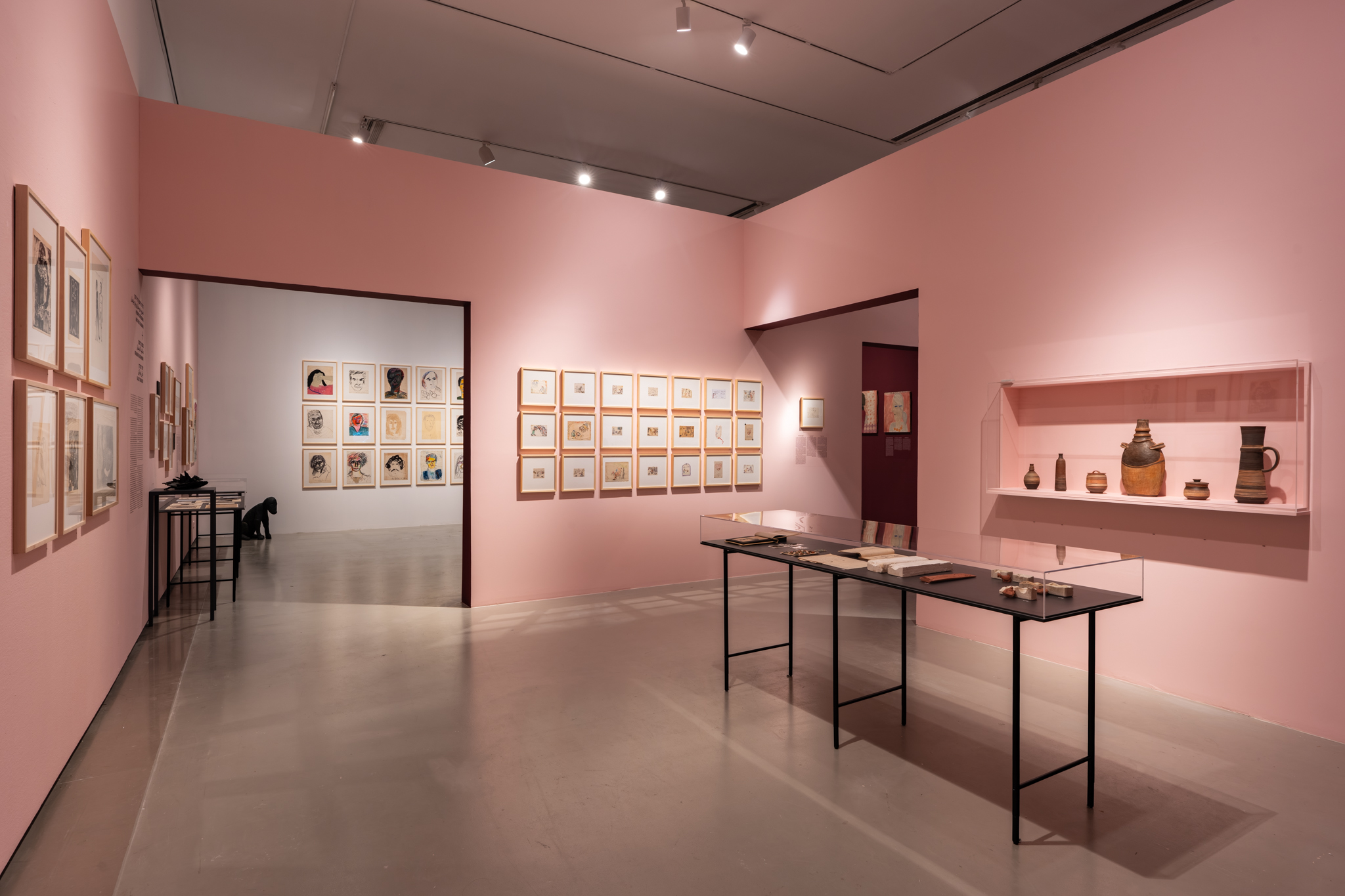
This exhibition displays the couple's public output – sculptures, ceramics, and prints – alongside drawings and illustrations that reveal the intimate space of their work. Among them are romantic drawings depicting fantasies of family life, naïve illustrations for birthday greetings or holiday cards, and portraits rendered with a subtle hand. The various means of expression – organized here around the themes of home, studio, and nature – reveal an artistic language that took shape through constant dialogue. Taken together, the materials reflect the couple's partnership as an anchor of stability, an autonomous space from which distinct creative practices emerged. Against the businesslike and rigorous public image both figures projected, the archive unveils moments of tenderness, humor, and romance, suggesting that love was not merely a backdrop to their work but a driving force that enabled and empowered it.